L'espace de travailThe workspace
Une page, trois colonnes, une équipe.One page, three columns, one team.
À gauche, les conversations de la personne et la bibliothèque : les agents, les compétences, la mémoire, les coûts, les applications IA. Au centre, le fil avec l'équipe. À droite, ce qui attend la personne : À approuver, À retenir, le Journal et les Fichiers. La même page sert deux contextes : sur un poste (127.0.0.1, un bandeau « Harnais local · ce poste » bien visible) ou dans le compte AWS de l'organisation, à son propre domaine.
On the left, the person's conversations and the library: agents, skills, memory, costs, AI applications. In the middle, the thread with the team. On the right, what waits for the person: To approve, To remember, the Journal and the Files. The same page serves two contexts: on a workstation (127.0.0.1, with a conspicuous "Local harness · this workstation" banner) or in the organization's AWS account, on its own domain.
Une ligne que le Node choisit de montrer à tout le monde : le bouton d'avertissement (⚠) de l'en-tête déplie une note en texte simple, de 400 caractères au plus — qui exploite la page, ce que les autres invités voient, où le modèle calcule, qui joindre. Elle s'ouvre d'elle-même la première fois qu'un navigateur en voit le texte, puis s'en souvient ; un texte nouveau s'ouvre de nouveau. Sur un écran d'ordinateur (plus de 960 px), la page est dessinée à 85 % pour montrer plus. A line the Node chooses to show everyone: the header's warning button (⚠) unfolds a plain-text note, 400 characters at most — who runs the page, what other guests see, where the model computes, whom to ask. It opens by itself the first time a browser sees its text, then remembers it; a new text opens again. On a computer screen (over 960 px), the page is drawn at 85% to show more.
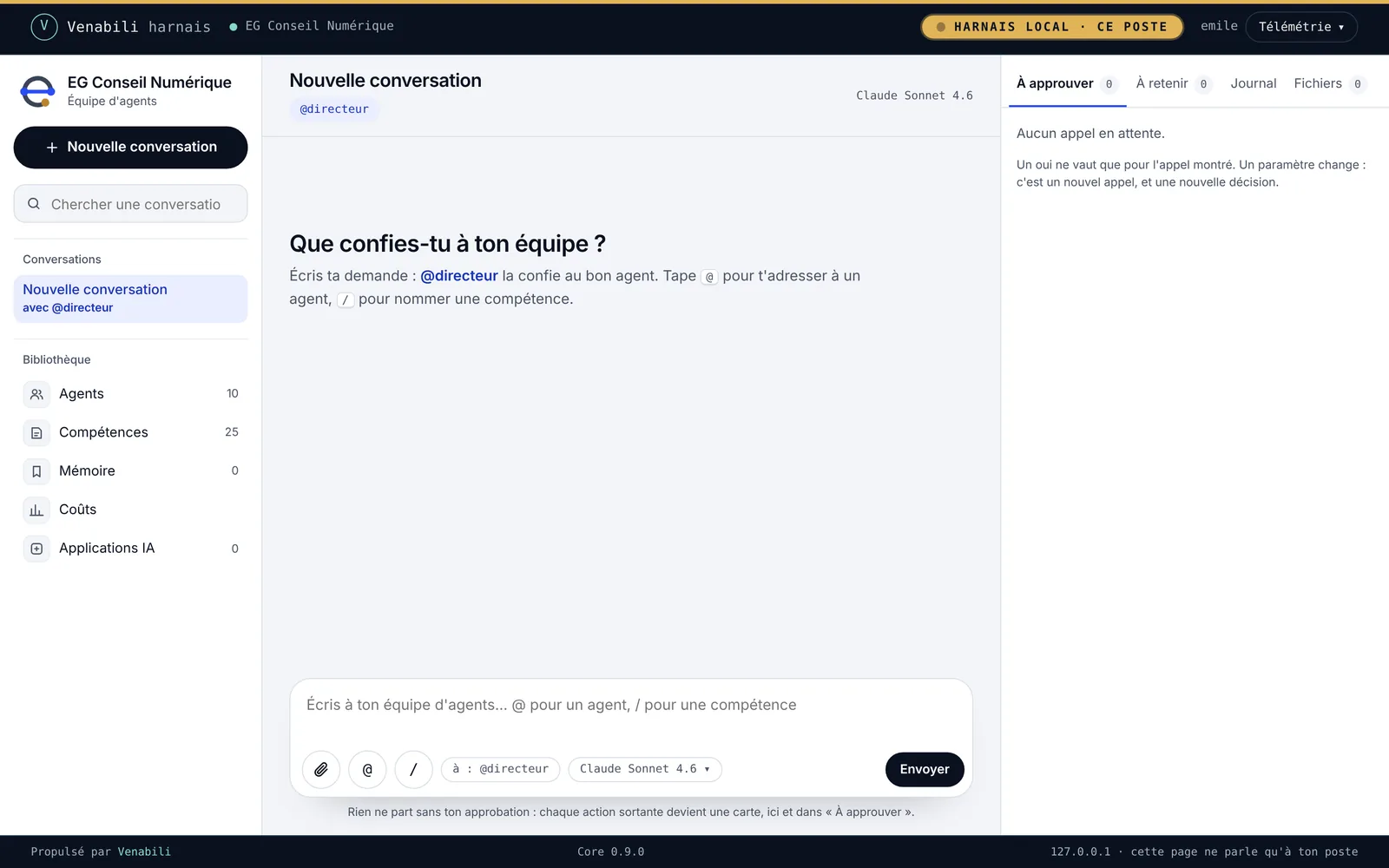
@ pour s'adresser à un agent, / pour nommer une compétence.A new conversation — you write to @directeur, who assigns the work; @ to address an agent, / to name a skill.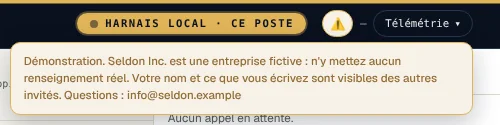
Une conversationA conversation
L'orchestrateur confie ; le spécialiste fait ; tout revient dans le même fil.The orchestrator assigns; the specialist does; everything comes back to the same thread.
La personne écrit. @directeur décide qui doit répondre et délègue par un outil, delegate_to_comptable par exemple : un agent neuf est construit pour cette tâche, la mène au bout et rend sa réponse. Le message de délégation doit porter trois sections — CONTEXTE, TÂCHE, FORMAT — et c'est vérifié dans le code : sans TÂCHE, la délégation est refusée avant qu'aucun agent ne soit construit. La chaîne s'arrête à deux niveaux, et personne ne délègue à l'orchestrateur ni à lui-même.
The person writes. @directeur decides who should answer and delegates through a tool, delegate_to_comptable for instance: a fresh agent is built for that task, carries it through and returns its answer. The delegation message must carry three sections — CONTEXT, TASK, FORMAT — and that is checked in code: without a TASK, the delegation is refused before any agent is built. The chain stops at two levels, and nobody delegates to the orchestrator or to themselves.
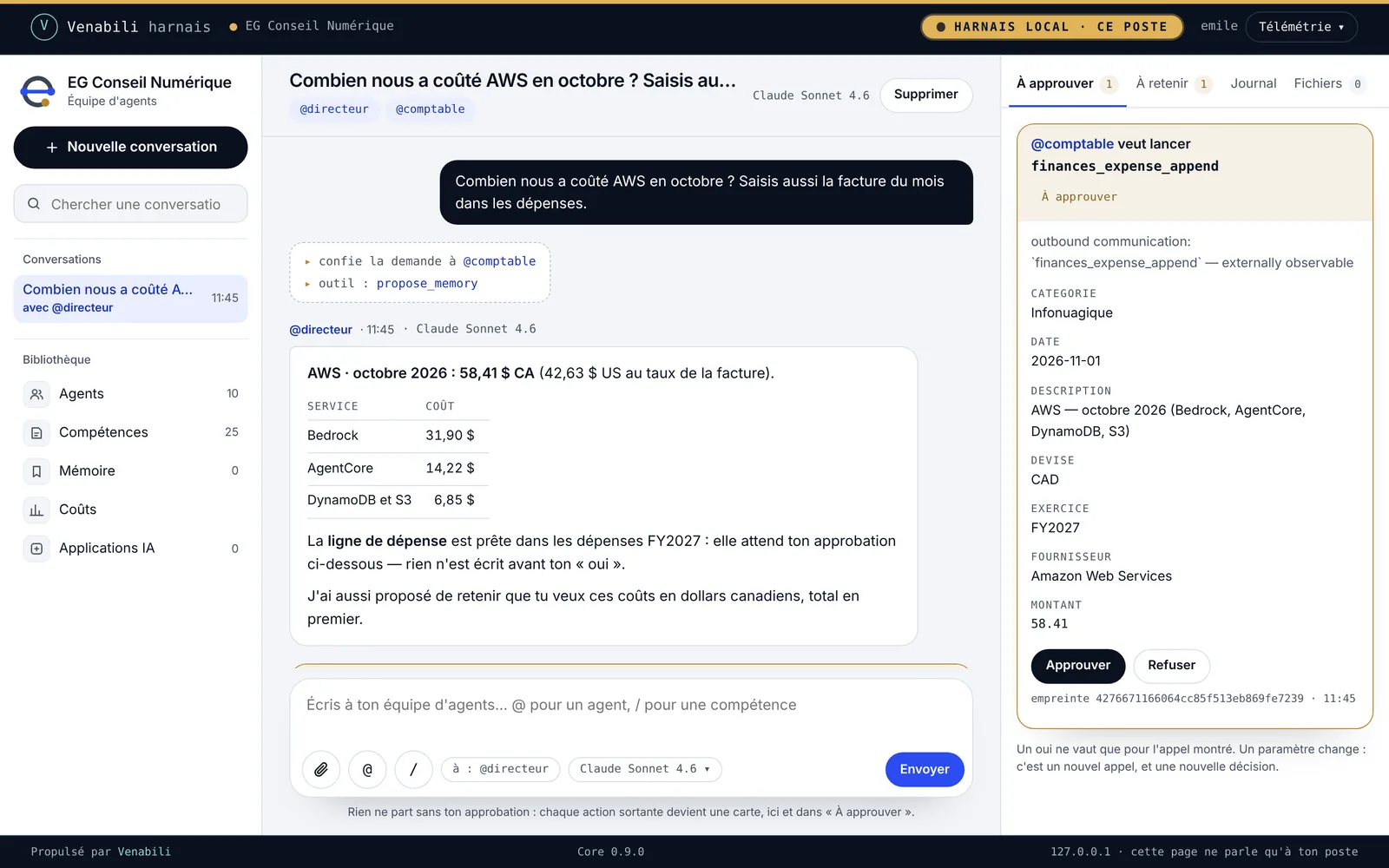
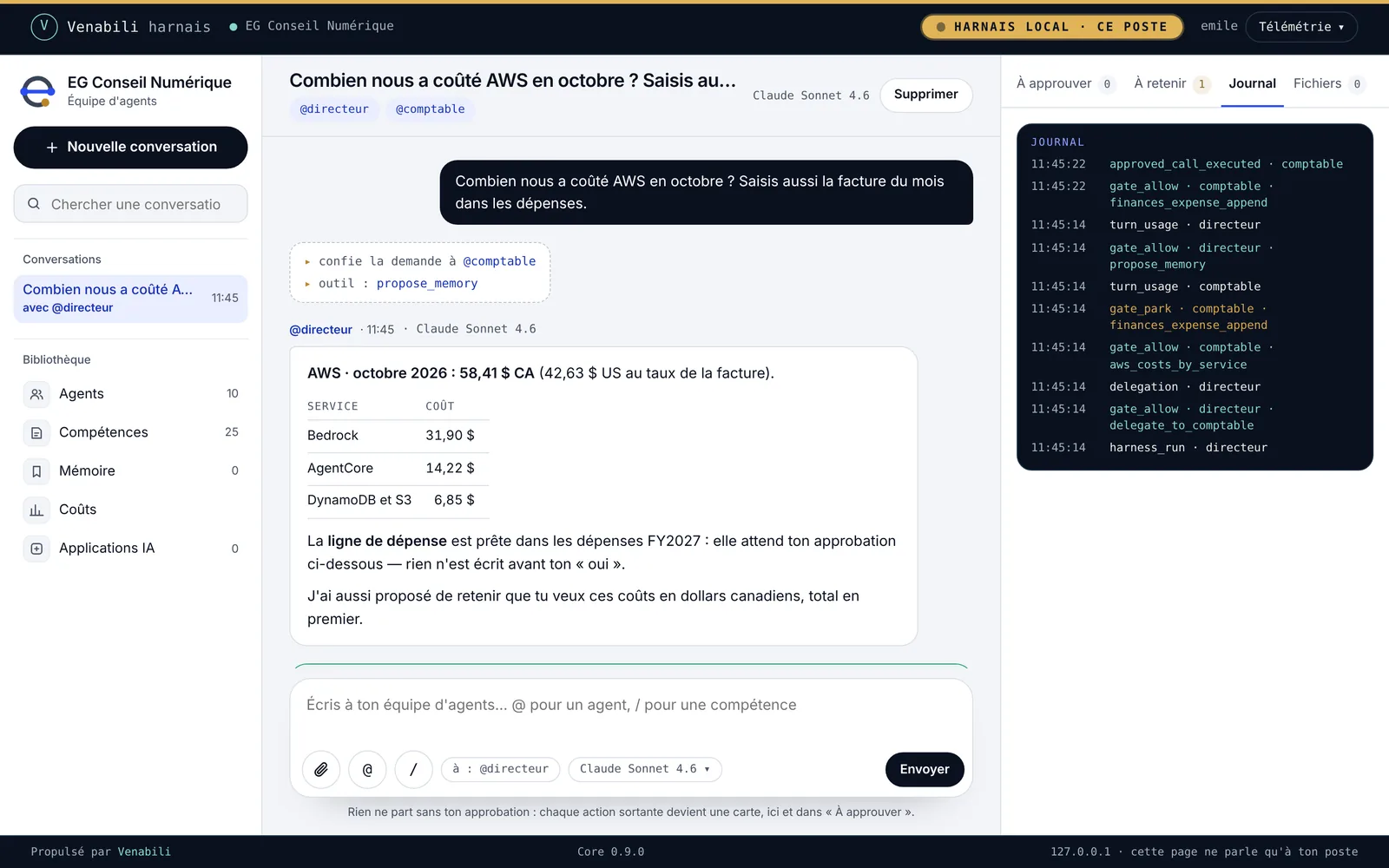
La réponse arrive en continu (événements AG-UI). Le fil montre les étapes — « confie la demande à @comptable », les outils appelés — et le modèle qui a écrit chaque réponse. Les conversations sont gardées par personne : sur un poste, dans le dossier du Node que git ignore ; dans le compte AWS, dans le compartiment de l'organisation à Montréal. Une nouvelle session les reprend là où elles étaient ; « Supprimer » les efface. The answer streams in (AG-UI events). The thread shows the steps — "assigns the request to @comptable", the tools called — and the model that wrote each answer. Conversations are kept per person: on a workstation, in the Node's folder that git ignores; in the AWS account, in the organization's bucket in Montréal. A new session picks them up where they were; "Delete" erases them.
Comment un agent est assembléHow an agent is put together
Une fiche devient un agent — avec ce qu'on lui permet, rien de plus.A card becomes an agent — with what it is allowed, nothing more.
Le harnais n'écrit rien de son cru : il relit les sources du Node — les fiches, les compétences, l'instance, les invariants du Core — et en compose chaque agent à la demande. Ses instructions s'empilent toujours dans le même ordre. Ses outils sont l'intersection de ce que sa fiche demande et de ce que la politique d'accès lui accorde. Une garde est branchée sur chacun de ses appels. The harness writes nothing of its own: it re-reads the Node's sources — cards, skills, instance, Core invariants — and composes each agent on demand. Its instructions always stack in the same order. Its tools are the intersection of what its card asks for and what the access policy grants it. A gate is hooked on every one of its calls.
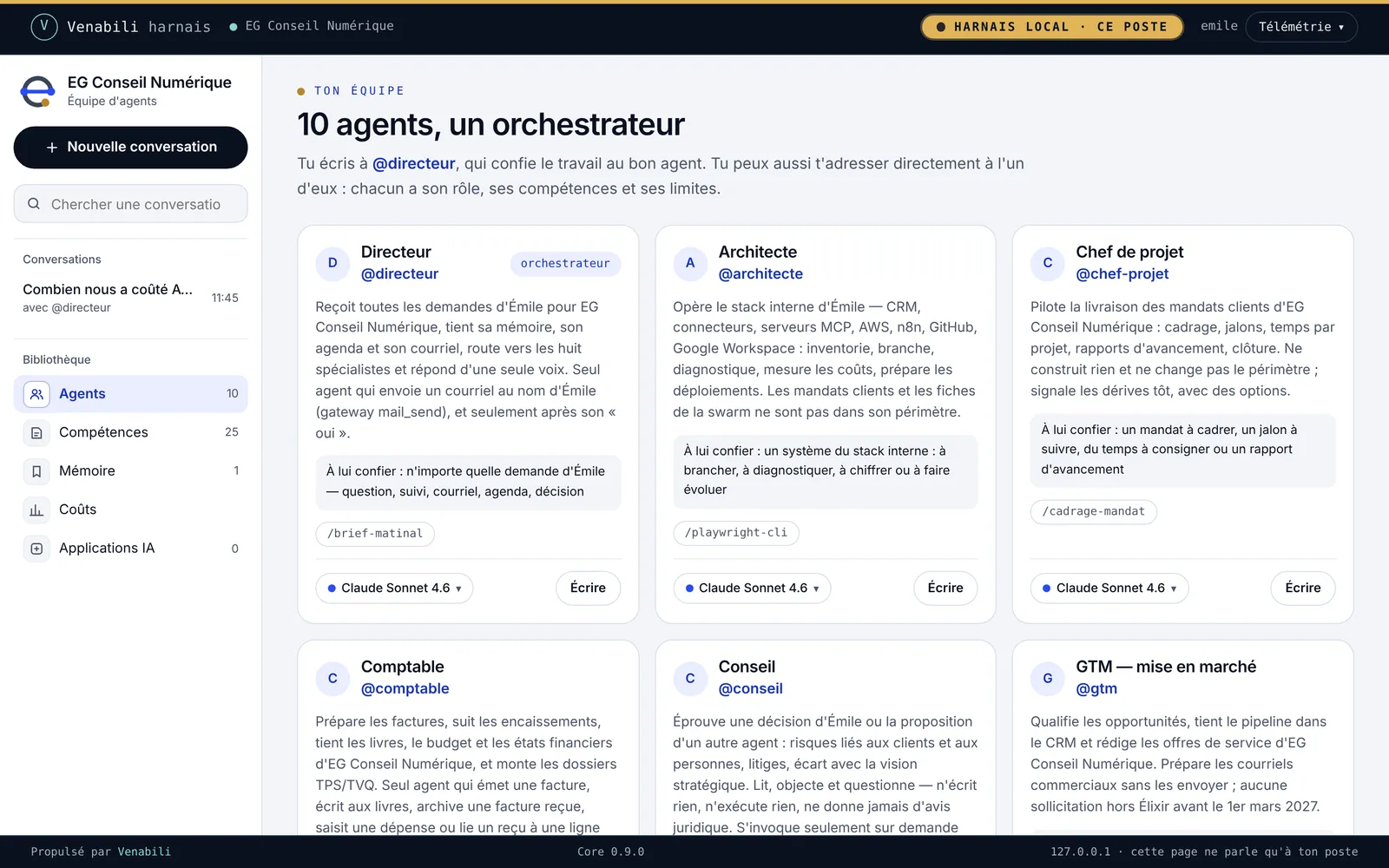
Rien n'est réécrit — les mêmes fiches servent le plugin dans Claude et le harnais ; seul l'assemblage change.Nothing is rewritten — the same cards serve the plugin in Claude and the harness; only the assembly changes.
Les approbationsApprovals
Ce qui sort ne part pas sur la parole d'un modèle.What goes out does not leave on a model's word.
Avant chaque appel, la garde tranche dans un ordre fixe. Un outil du harnais (une délégation, une compétence) passe. Un outil lié à aucun groupe de droits, ou qui appartient à la passerelle d'un autre agent, est refusé. Un droit qui n'est pas accordé à cet agent, à ce niveau de risque, sur ce poste : refusé. Une lecture passe. Une action sortante — courriel, publication, écriture dans les livres, tout ce qu'on ne reprend pas — n'est pas exécutée : elle est mise en attente et devient une carte avec les paramètres exacts. Before every call, the gate decides in a fixed order. A harness tool (a delegation, a skill) goes through. A tool bound to no rights group, or that belongs to another agent's gateway, is refused. A right not granted to this agent, at this risk level, on this workstation: refused. A read goes through. An outbound action — an email, a publication, a write to the books, anything that cannot be taken back — is not run: it is parked and becomes a card with the exact parameters.
La carte apparaît dans la conversation et dans « À approuver ». Deux gestes : Approuver, puis Confirmer : exécuter. L'appel part alors une fois, tel qu'il a été montré. Son empreinte lie l'agent, l'outil et les paramètres : un autre agent ne peut pas l'exécuter, et un paramètre qui change est un autre appel, donc une autre décision. Le modèle n'a aucun outil pour écrire dans le registre des approbations. The card appears in the conversation and in "To approve". Two gestures: Approve, then Confirm: run. The call then leaves once, as it was shown. Its fingerprint binds the agent, the tool and the parameters: another agent cannot run it, and a parameter that changes is another call, hence another decision. The model has no tool that writes to the approvals register.
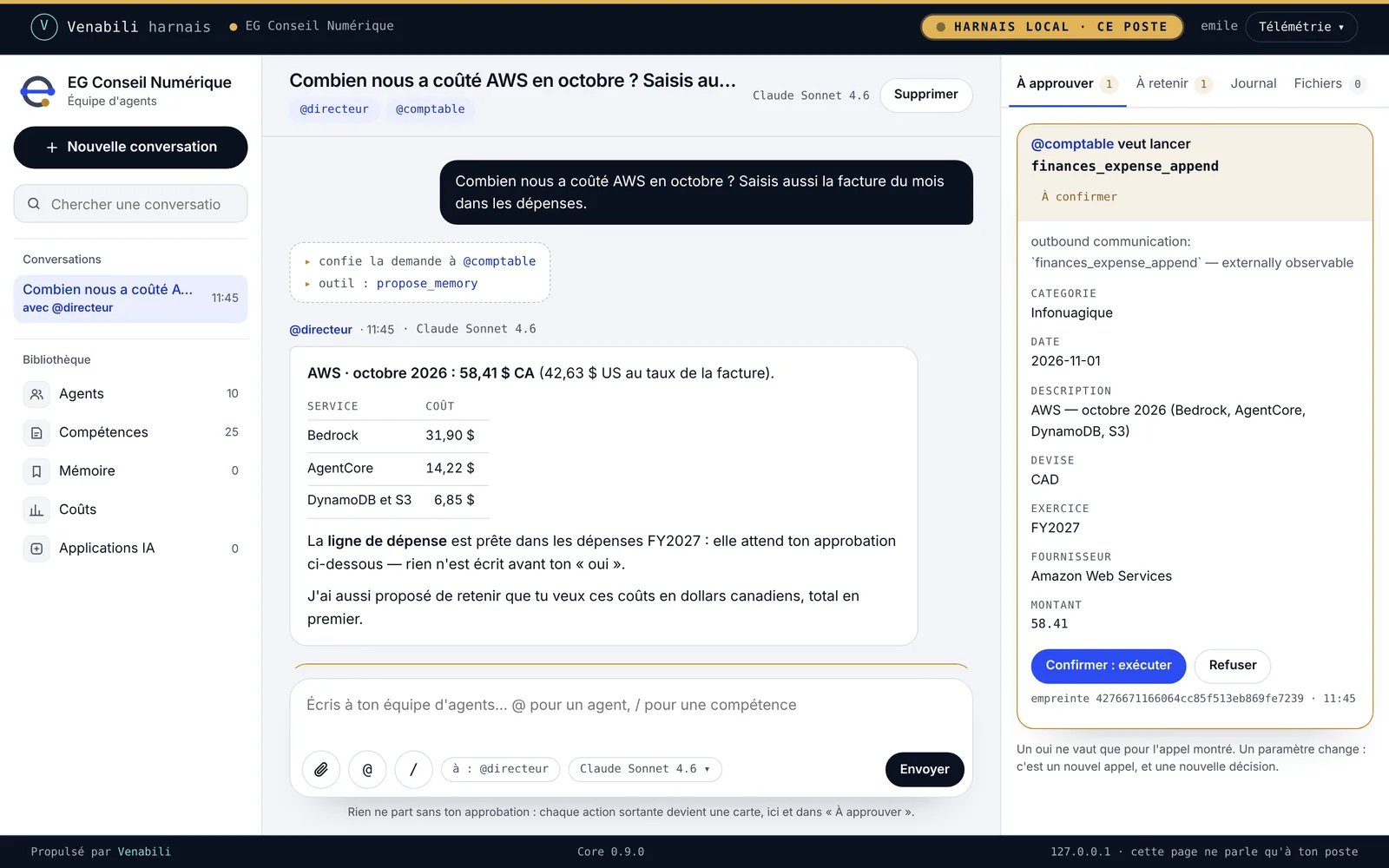
Dans le compte AWS — chaque transition est une écriture conditionnelle : deux sessions ne peuvent pas dépenser la même approbation. L'approbateur est la personne que nomme son jeton vérifié, jamais une machine.In the AWS account — every transition is a conditional write: two sessions cannot spend the same approval. The approver is the person their verified token names, never a machine.
Le choix des modèlesChoosing models
Un modèle par agent, essayé dans une conversation avant d'être adopté.One model per agent, tried in a conversation before it is adopted.
L'organisation déclare son catalogue dans l'instance du Node : Claude, GPT, Qwen, chacun avec son identifiant. AWS dit, à chaque vérification et à chaque déploiement, lesquels sont ouverts au compte et à quel prix — la réponse est datée. Pour chaque agent, le modèle se résout dans cet ordre : l'essai fait dans cette conversation, sinon l'exception de l'agent, sinon le modèle de son palier (orchestration, spécialiste, passerelle). L'effort de raisonnement suit la fiche. The organization declares its catalogue in the Node's instance: Claude, GPT, Qwen, each with its id. AWS says, at every check and every deploy, which ones are open to the account and at what price — the answer is dated. For each agent, the model resolves in this order: the trial made in this conversation, else the agent's exception, else its tier's model (orchestration, specialist, gateway). Reasoning effort follows the card.
Un essai ne touche que la conversation — un agent délégué le suit, le reste de l'équipe non. Pour l'adopter, la page propose un changement au Node par le connecteur d'édition, que l'on approuve dans la console Venabili. Le poste peut avoir ses propres réglages (harness.local, seulement ce qui diffère) ; la page distingue nettement les modèles externes des modèles locaux, dont le groupe est déjà dessiné — leur exécution sur le poste est en préparation.
A trial touches only the conversation — a delegated agent follows it, the rest of the team does not. To adopt it, the page proposes a change to the Node through the edit connector, approved in the Venabili console. The workstation may have its own settings (harness.local, only what differs); the page clearly separates external models from local ones, whose group is already drawn — running them on the workstation is in preparation.
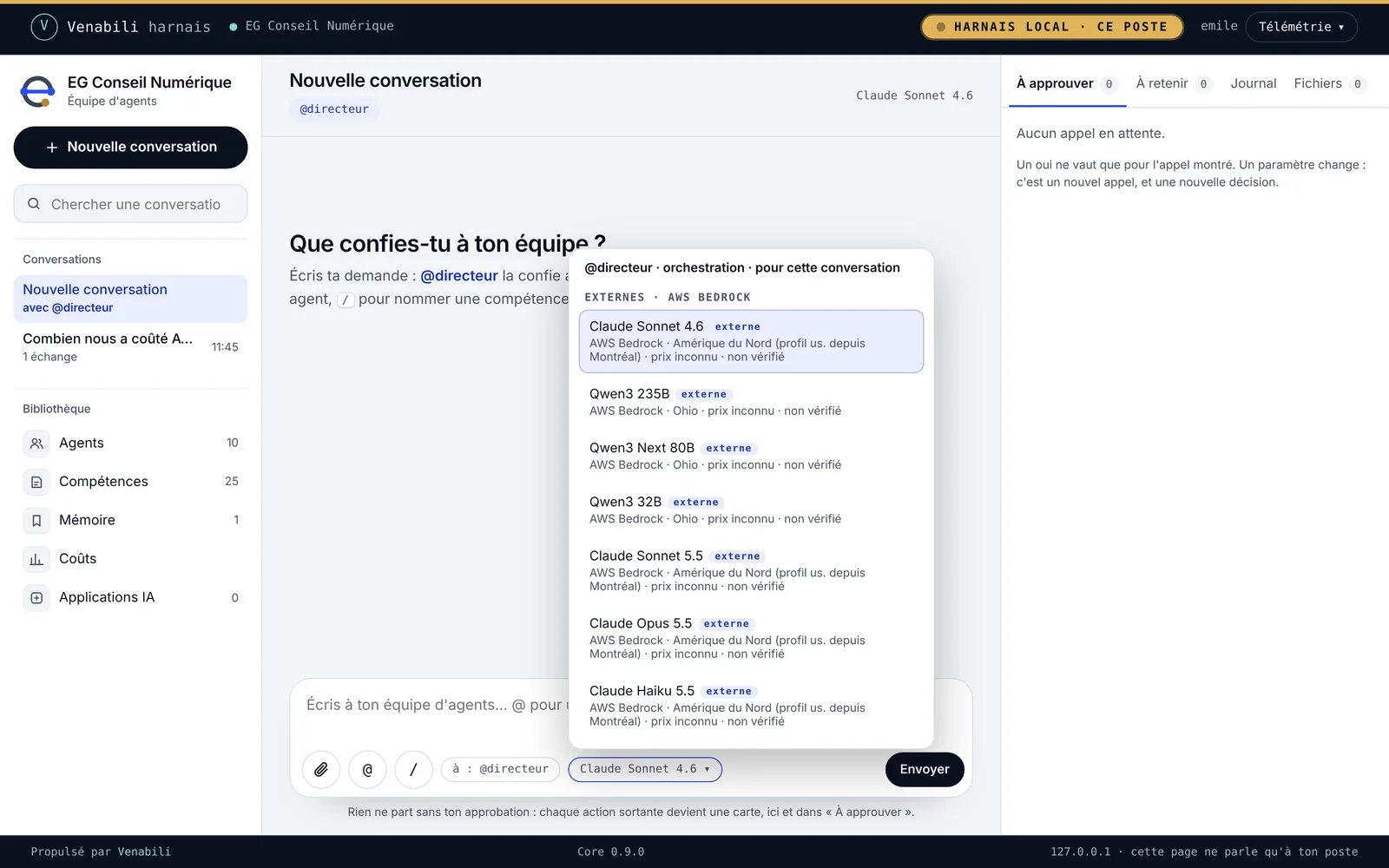
Ce que l'on dit au client — données au repos au Québec, calcul en Amérique du Nord. Avant le premier appel hors du Québec : une évaluation des facteurs relatifs à la vie privée.What we tell the client — data at rest in Québec, computing in North America. Before the first call outside Québec: a privacy impact assessment.
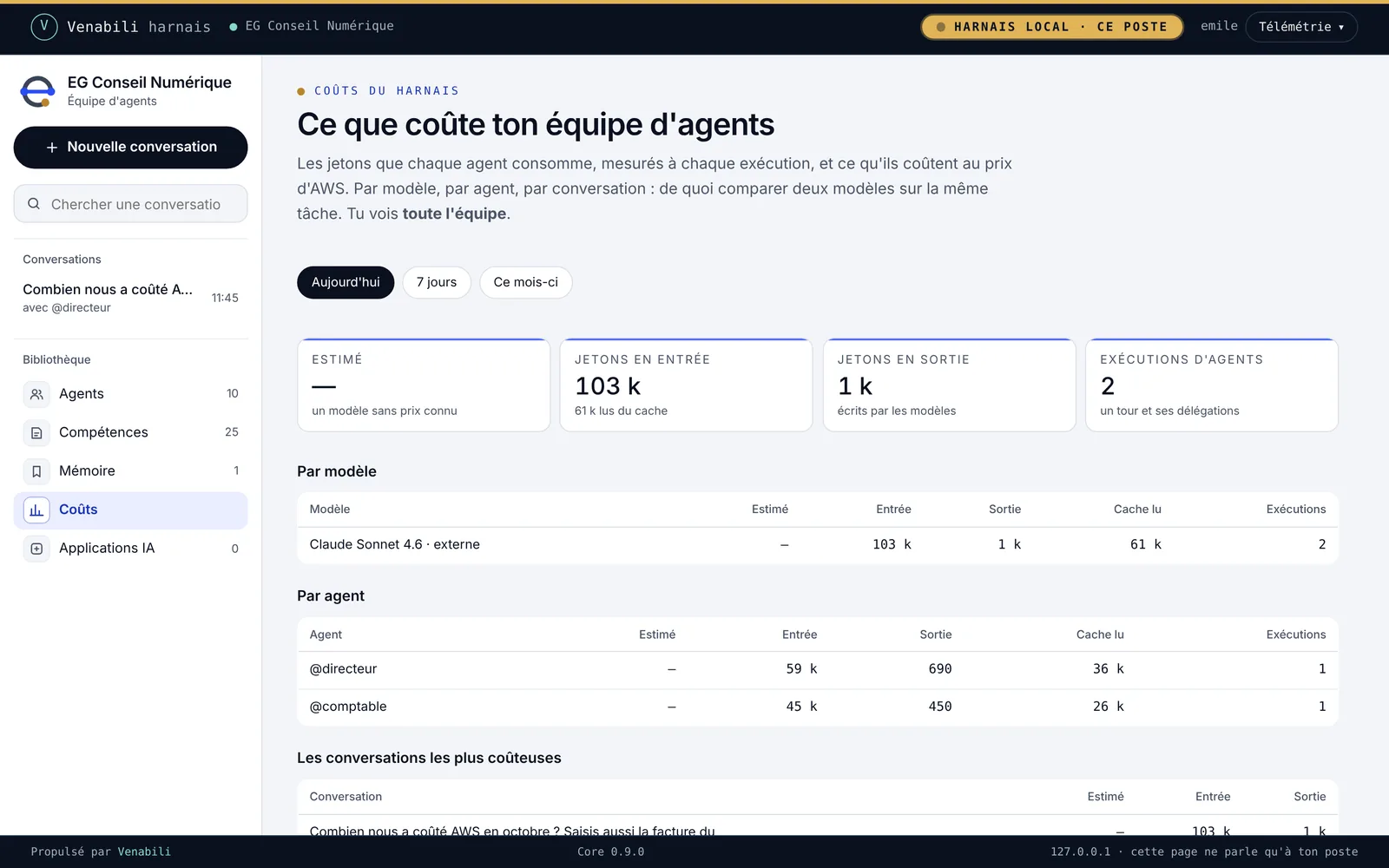
Chaque exécution d'agent compte ses jetons — en entrée, en sortie, lus du cache. La vue Coûts les additionne par modèle, par agent et par conversation, aujourd'hui, sur 7 jours ou sur le mois, et les estime au prix d'AWS quand le prix est connu sans ambiguïté ; sinon elle le dit. De quoi comparer deux modèles sur la même tâche, chiffres en main. Le cache des instructions est actif par défaut. Every agent run counts its tokens — input, output, read from cache. The Costs view adds them up by model, by agent and by conversation, today, over 7 days or the month, and estimates them at AWS's price when the price is known without ambiguity; otherwise it says so. Enough to compare two models on the same task, numbers in hand. Instruction caching is on by default.
La mémoireMemory
Les agents proposent. La personne retient.The agents propose. The person keeps.
La mémoire est éteinte tant que le Node ne l'allume pas. Allumée, chaque agent dispose d'un outil interne, propose_memory : une phrase, et sa portée — toi, l'entreprise, ou un agent précis. Une proposition n'est pas un souvenir : elle attend dans « À retenir », et la personne la garde, la corrige ou l'oublie. Ce qui est gardé entre dans les instructions de tous les agents, à chaque échange ; une réponse qui s'en sert l'affiche — « S'appuie sur 2 souvenirs ».
Memory is off until the Node turns it on. Once on, every agent has an internal tool, propose_memory: one sentence, and its scope — you, the company, or one agent. A proposal is not a memory: it waits in "To remember", and the person keeps it, corrects it or forgets it. What is kept enters every agent's instructions, at every exchange; an answer that relies on it shows it — "Relies on 2 memories".
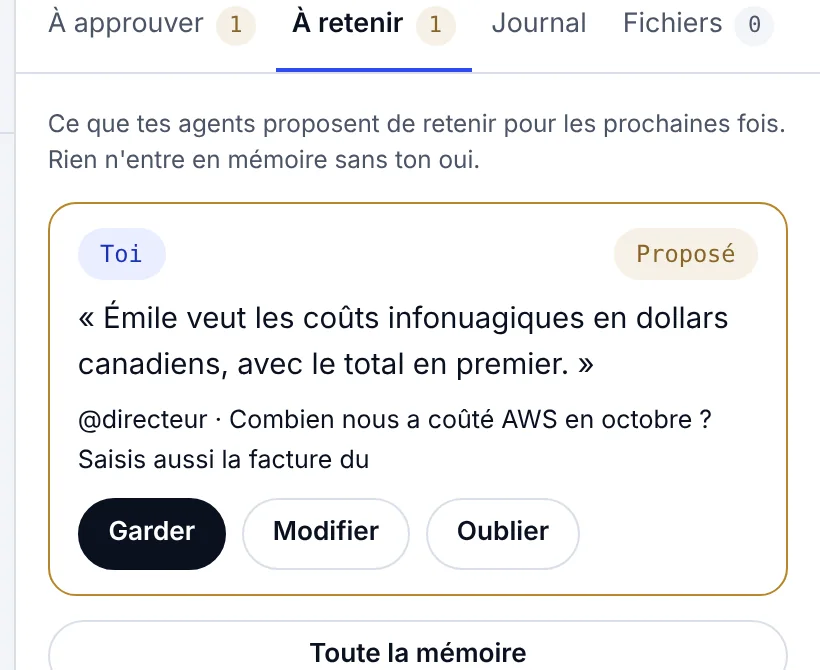
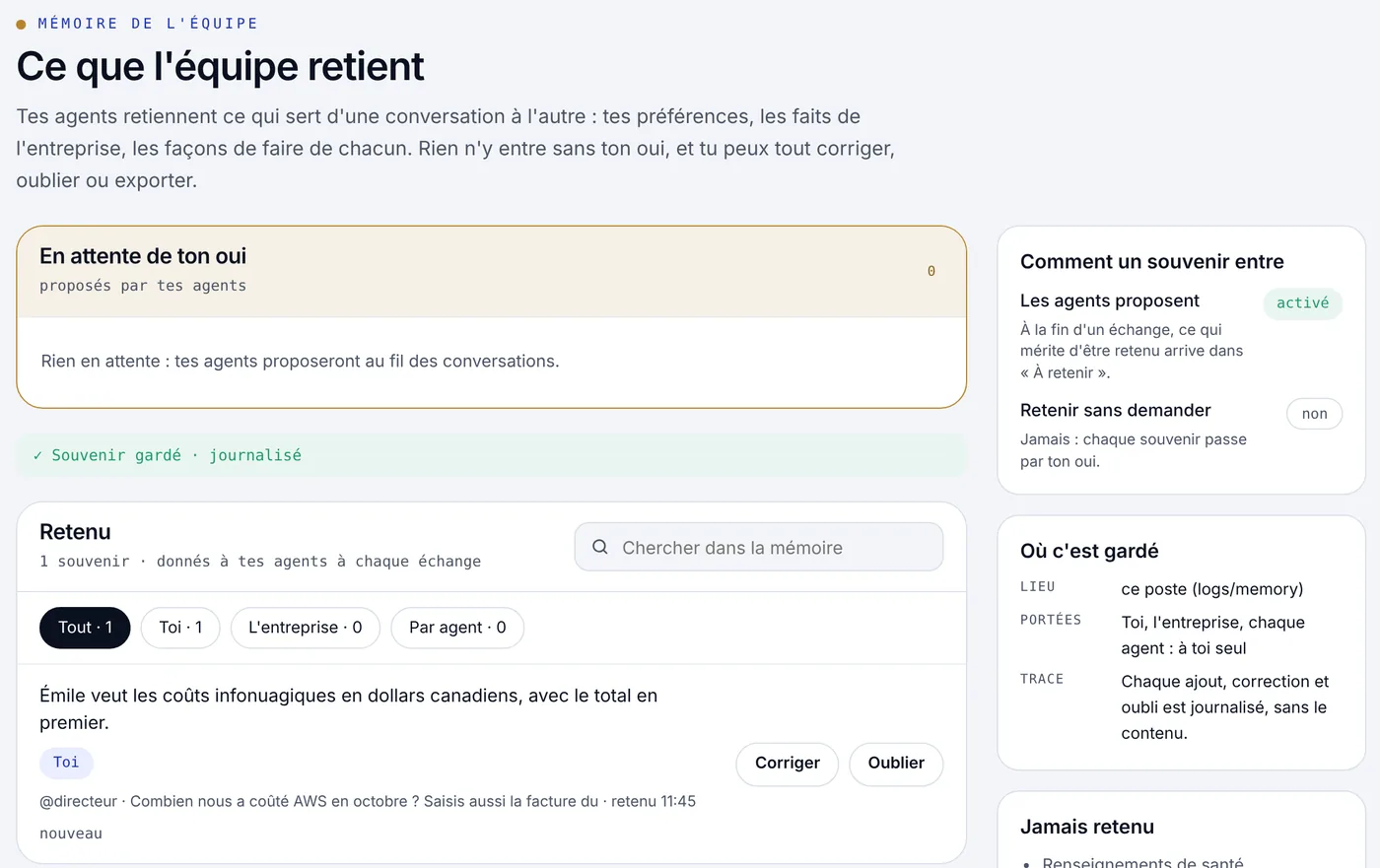
Rien n'est retenu sans un oui — un agent ne peut que proposer ; il n'existe aucun « retenir sans demander ».Nothing is kept without a yes — an agent can only propose; there is no "remember without asking".
Les documents de l'organisationThe organization's documents
Ce que toute l'équipe lit, et que rien ne change sans qu'une personne le garde.What the whole team reads, and nothing changes until a person keeps it.
Dans « Mémoire », à côté des souvenirs, l'onglet Documents garde les textes communs de l'organisation, en Markdown : un dictionnaire de marchands, un glossaire, une procédure. Toutes les personnes de l'organisation et tous ses agents les lisent — liste, lecture, recherche. Un agent ne peut que proposer un document neuf ou une nouvelle version ; la proposition attend dans l'onglet, et la personne la garde. Une personne peut aussi modifier un document sur la page (dans le compte AWS, avec le droit d'approuver). In "Memory", beside the memories, the Documents tab keeps the organization's shared texts, in Markdown: a merchant dictionary, a glossary, a procedure. Every person of the organization and every agent reads them — list, read, search. An agent can only propose a new document or a new version; the proposal waits in the tab, and the person keeps it. A person can also change a document on the page (in the AWS account, with the right to approve).
L'éditeur ouvre le document en texte enrichi — titres, gras, italique, liens, tableaux — et le Markdown reste le document : un clic le montre tel quel, et un document que l'on n'a pas touché est enregistré tel qu'il était écrit. The editor opens the document as rich text — headings, bold, italic, links, tables — and the Markdown stays the document: one click shows it as it is, and a document left untouched is saved as it was written.
harness.documents: on).On a workstation, in the Node's folder that git ignores; in the AWS account, in the organization's bucket in Montréal. The Node turns documents on in its instance (harness.documents: on).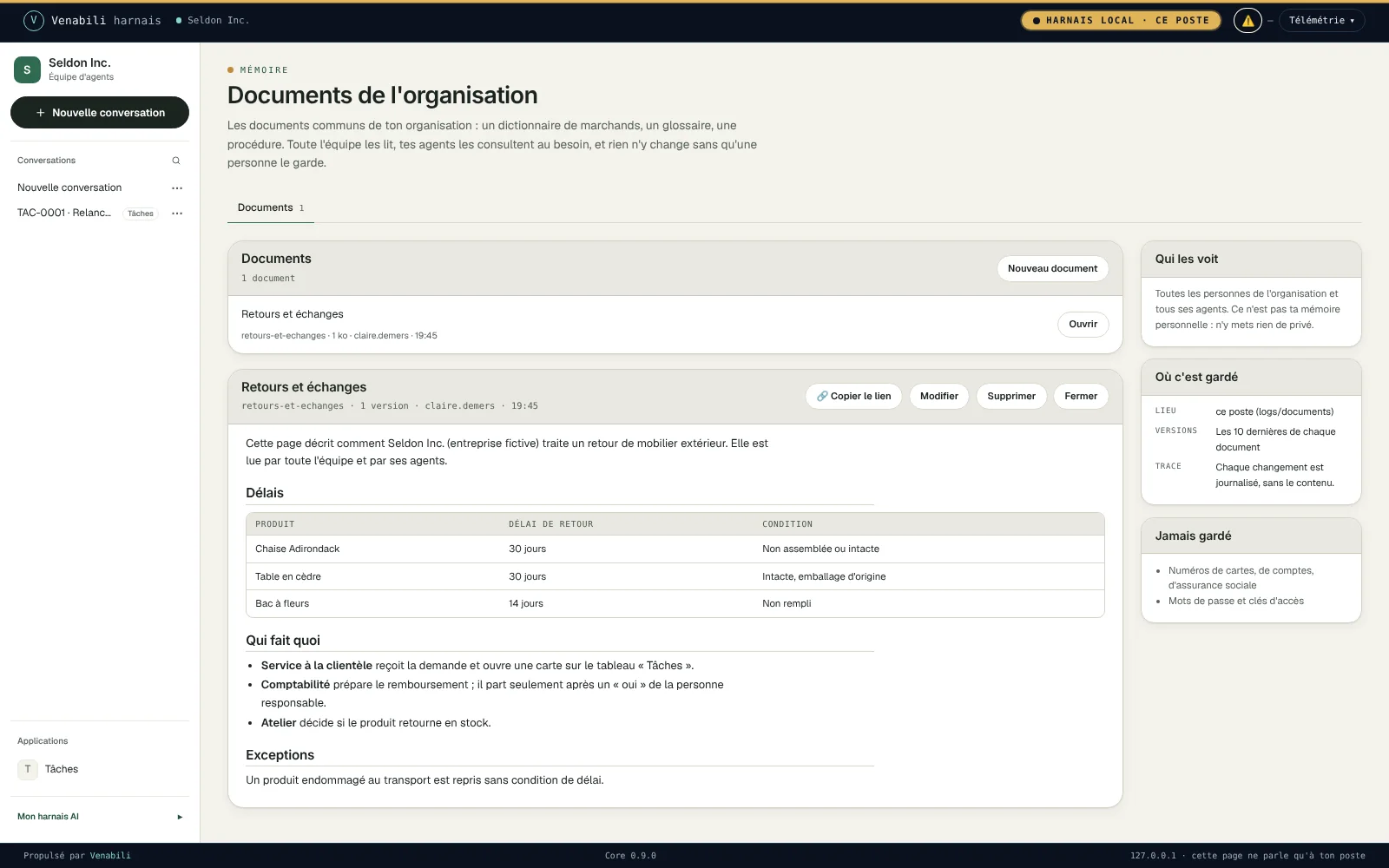
Les applications IAAI applications
Une application est un canal de plus vers la même équipe.An application is one more channel into the same team.
Un appel téléphonique, un formulaire du site, un courriel entrant, un écran pour une équipe : le canal transforme l'événement en demande, le harnais la confie aux agents, avec leurs outils, leurs règles et leur journal. L'application n'invente rien — elle hérite de la résidence, des approbations, des droits des personnes et du choix des modèles. Chacune est déclarée dans l'instance du Node, avec sa topologie. Si le Node nomme un contact (courriel ou adresse https), la vue propose aussi une tuile « Créer une nouvelle app » qui lui écrit ; sans contact, elle n'apparaît pas. A phone call, a website form, an incoming email, a screen for a team: the channel turns the event into a request, the harness hands it to the agents, with their tools, rules and journal. The application invents nothing — it inherits residency, approvals, people's rights and model choice. Each one is declared in the Node's instance, with its topology. If the Node names a contact (an email or an https address), the view also offers a "Créer une nouvelle app" tile that writes to it; without a contact, it does not appear.
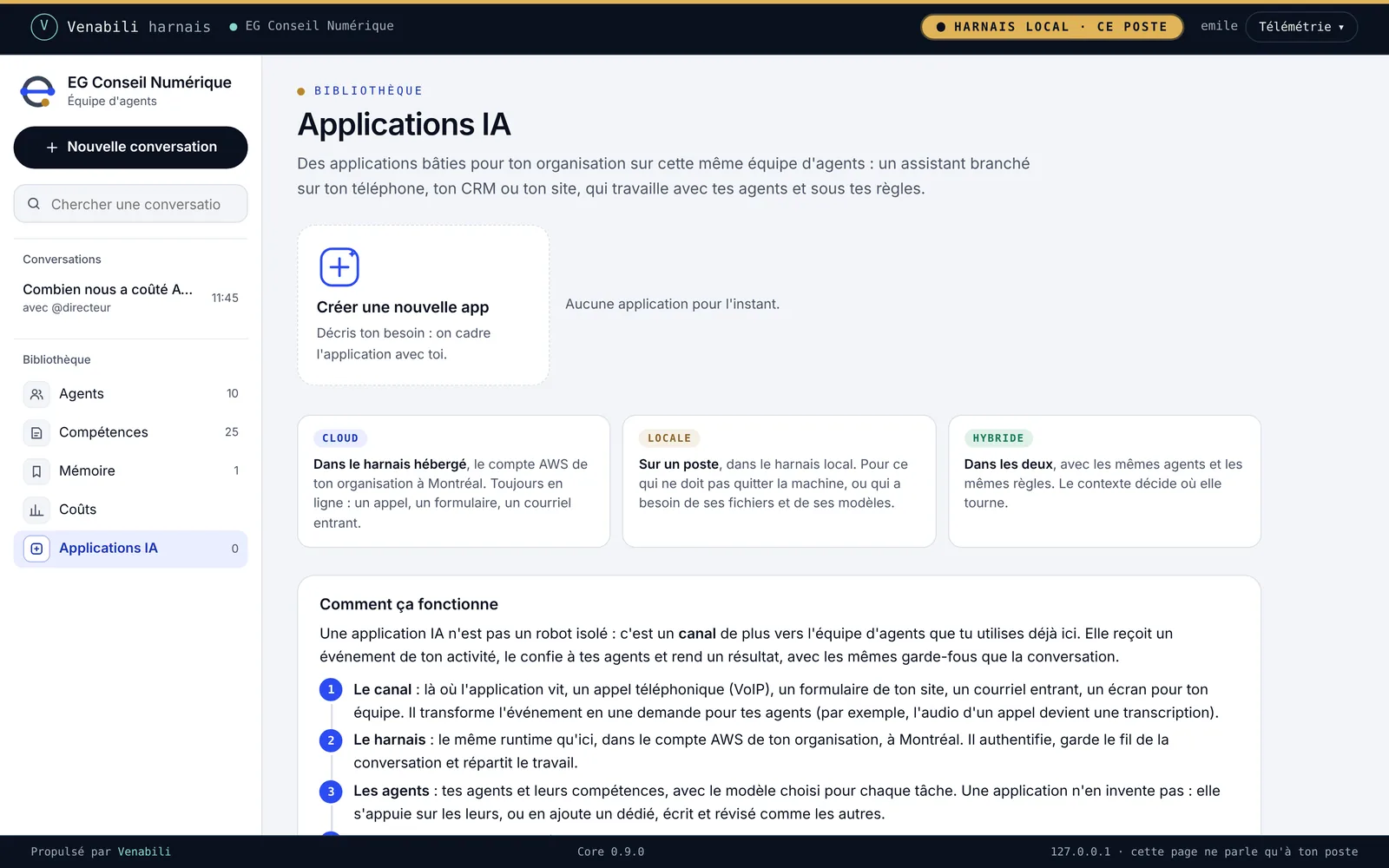
cloud
Dans le harnais hébergéIn the hosted harness
Le compte AWS de l'organisation, à Montréal. Toujours en ligne : un appel, un formulaire, un courriel entrant.The organization's AWS account, in Montréal. Always on: a call, a form, an incoming email.
localelocal
Sur un posteOn a workstation
Pour ce qui ne doit pas quitter la machine, ou qui a besoin de ses fichiers et de ses modèles.For what must not leave the machine, or needs its files and its models.
hybridehybrid
Dans les deuxIn both
Les mêmes agents, les mêmes règles ; le contexte décide où elle tourne.The same agents, the same rules; the context decides where it runs.
Le tableau « Tâches »The "Tâches" board
Une carte se confie à une personne, ou à un agent qui se met au travail.A card goes to a person, or to an agent that gets to work.
Le tableau est une application du harnais, éteinte tant que le Node ne l'allume pas. Une phrase fait une carte (@agent, #étiquette, un jour de la semaine ou une date). Chaque carte a un demandeur, un responsable — une personne de l'équipe ou un agent du Node —, une échéance, des étiquettes et des liens : une conversation, un document, une page. Les colonnes portent chacune l'un de cinq sens — boîte de réception, à faire, en cours, en attente, fait — que l'administrateur nomme et ordonne ; les règles lisent le sens, jamais le nom, et « en attente » dit qui l'on attend. Chaque membre écrit une carte sans attendre de « oui » ; la corbeille et les réglages sont à l'administrateur.
The board is an application of the harness, off until the Node turns it on. A sentence makes a card (@agent, #label, a weekday or a date). Each card has a requester, an assignee — a person of the team or an agent of the Node —, a due date, labels and links: a conversation, a document, a page. Each column carries one of five meanings — inbox, to do, in progress, waiting, done — which the administrator names and orders; the rules read the meaning, never the name, and "waiting" says whom we wait for. Every member writes a card without waiting for a "yes"; the bin and the settings belong to the administrator.
Confier une carte à un agent la lance — tout de suite, ou par un bouton « Lancer », selon le réglage de l'agent. L'agent travaille dans la conversation propre de la carte, avec des outils de tableau : lire, créer, commenter, déplacer, rendre son résultat. Son résultat devient un commentaire, et la carte attend alors la personne qui l'a demandée : elle valide et ferme, ou relance l'agent avec une consigne. Un agent ne lance jamais un autre agent et ne ferme jamais une carte. Giving a card to an agent launches it — at once, or through a "Launch" button, depending on the agent's setting. The agent works in the card's own conversation, with board tools: read, create, comment, move, hand in its result. Its result becomes a comment, and the card then waits for the person who asked: they approve and close, or relaunch the agent with an instruction. An agent never launches another agent and never closes a card.
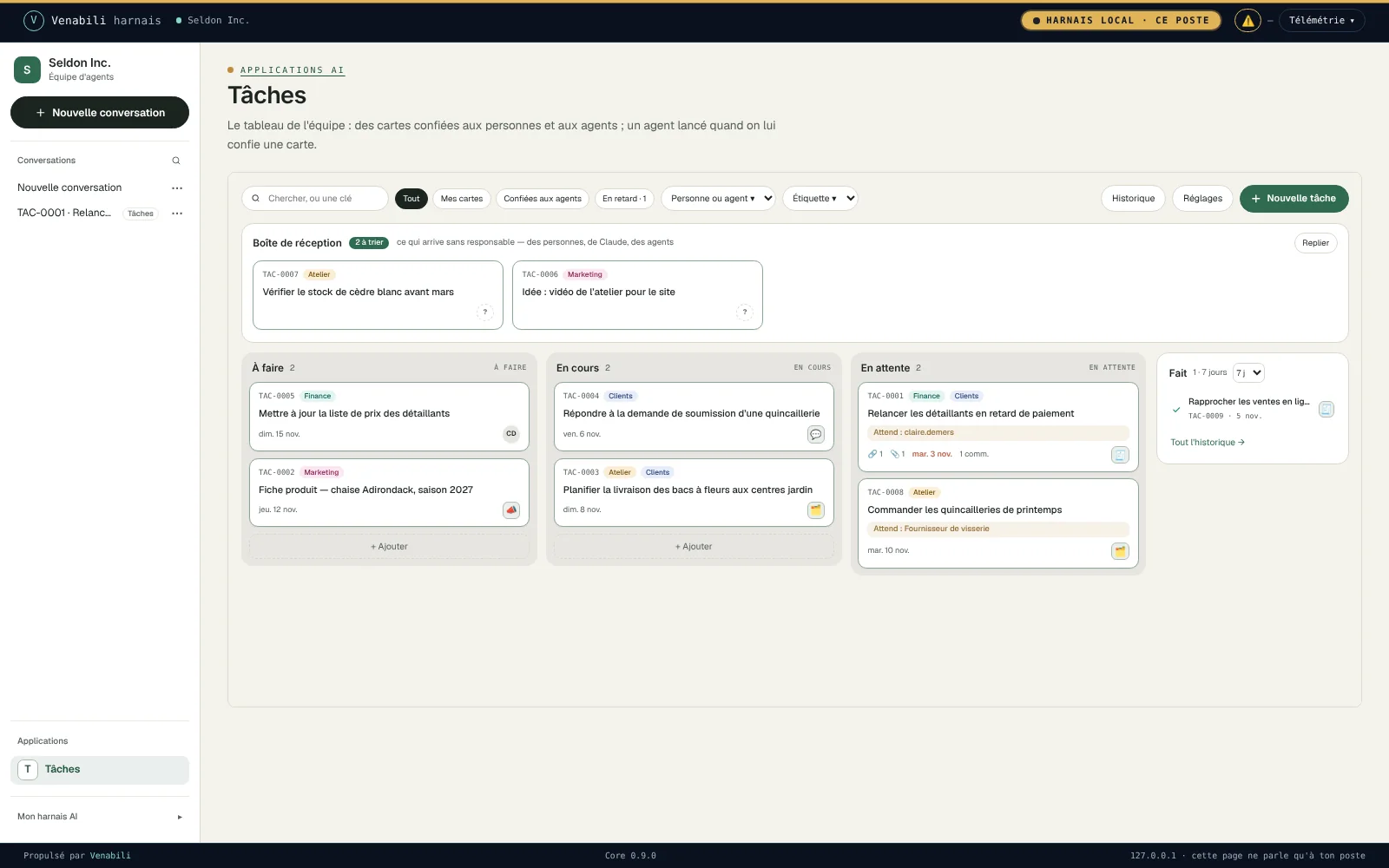
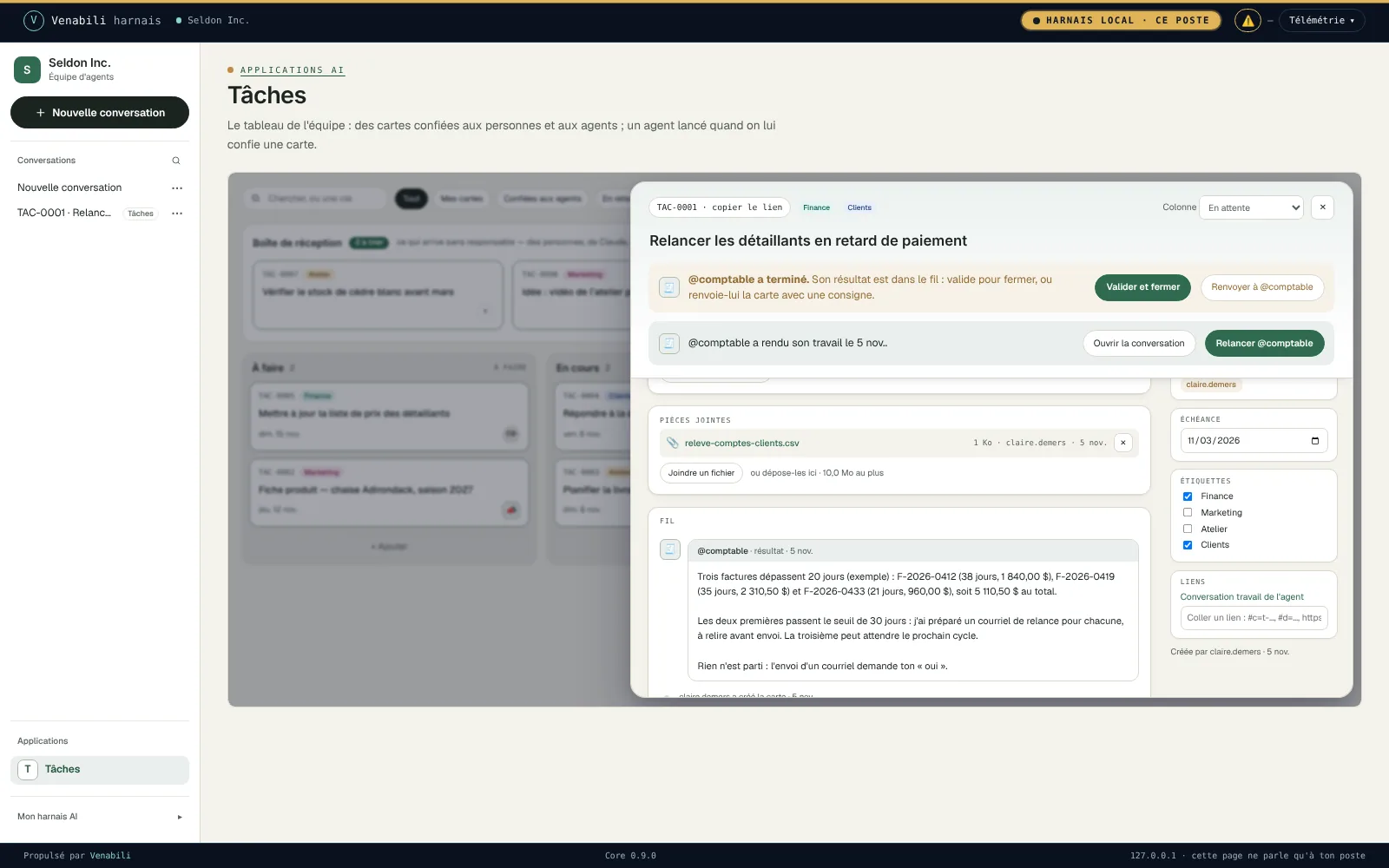
L'agent rend, la personne ferme — un agent ne peut ni en lancer un autre ni clore une carte.The agent hands in, the person closes — an agent can neither launch another nor close a card.
L'équipe et les invitationsThe team and invitations
Inviter, changer un rôle, retirer : depuis la page, par l'administrateur de l'organisation.Invite, change a role, remove: from the page, by the organization's administrator.
Dans le compte AWS, la personne dont le rôle porte le droit d'équipe — admin, par défaut — gère les gens du Node depuis la vue Équipe, sans entrer dans la console du fournisseur d'identité : elle invite par courriel avec un rôle, change le rôle d'une personne ou la retire. Trois rôles de départ : membre, qui parle à l'équipe d'agents ; approbateur, qui approuve en plus les actions sortantes ; admin, qui gère en plus les personnes. Le Node peut en déclarer d'autres. L'invitation crée le compte s'il n'existe pas, puis affiche, une seule fois, un lien d'invitation que l'administrateur transmet dans son propre courriel : il sert une fois, vaut sept jours, et la personne y choisit son mot de passe. Si le Node le choisit (invite_email), c'est le courriel de changement de mot de passe du fournisseur d'identité qui part à la place.
In the AWS account, the person whose role holds the team right — admin, by default — manages the Node's people from the Team view, without entering the identity provider's console: they invite by email with a role, change a person's role, or remove them. Three starting roles: member, who talks to the team of agents; approver, who also approves outbound actions; admin, who also manages the people. The Node can declare others. An invitation creates the account if it does not exist, then shows, once, an invitation link that the administrator hands over in their own email: it works once, lasts seven days, and the person chooses their password through it. If the Node opts in (invite_email), the identity provider's own change-password email goes out instead.
Un retrait coupe l'accès avant d'effacer — l'accès tout de suite, les données après trente jours.A removal cuts access before it erases — access at once, data after thirty days.
--auth0-plan, rien n'est changé), l'application ensuite, après un « oui » (--auth0-apply). Créer le compte du locataire reste un geste de la personne : aucune API ne le fait.A script prepares the identity provider's tenant from the Node's instance: the plan first (--auth0-plan, nothing changes), then the application, after a "yes" (--auth0-apply). Creating the tenant's account stays a person's gesture: no API does it.Le connecteur « Harnais »The "Harnais" connector
Le harnais est aussi un serveur MCP : Claude y lit, y propose, y confie — jamais n'y décide.The harness is also an MCP server: Claude reads, proposes and hands over — and never decides there.
Un client MCP comme Claude ajoute le harnais sous le nom « Harnais » — dans le compte AWS, à un domaine à part de celui de la page ; sur un poste, à l'adresse locale, avec le jeton du poste. Il y fait ce que la personne ferait sur la page : lire sa mémoire, les documents, les conversations, les coûts et ce qui attend son approbation ; proposer un souvenir ou un document ; confier une demande à l'équipe d'agents ; déposer un fichier ; et, là où le tableau est allumé, créer, commenter, déplacer et lancer des cartes. L'écran d'une application s'ouvre aussi dans le client. An MCP client such as Claude adds the harness under the name "Harnais" — in the AWS account, at a domain of its own, apart from the page's; on a workstation, at the local address, with the workstation's token. It does there what the person would do on the page: read their memory, the documents, the conversations, the costs and what waits for their approval; propose a memory or a document; hand a request to the team of agents; deposit a file; and, where the board is on, create, comment on, move and launch cards. An application's screen opens in the client too.
Un outil lit, propose ou confie — aucun n'approuve, aucun ne garde.A tool reads, proposes or hands over — none approves, none keeps.
read ou write, que le rôle de la personne lui donne ou non. La vérification du Core (doctor) refuse tout outil qui déciderait. Les outils du tableau n'existent que là où le tableau est allumé.A single registry describes the tools; each requires a right, read or write, which the person's role grants or not. The Core's check (doctor) refuses any tool that would decide. The board's tools exist only where the board is on.kept_tokens: on).By default, a person's token serves only the time of the request. For a call from Claude — with no page open — to act with their rights on one of the organization's connectors, the person can accept, connector by connector, that their refresh token be kept, sealed by the runtime's KMS key. It is a Node option (kept_tokens: on).Le journal et la télémétrieThe journal and telemetry
Chaque décision laisse une ligne. Aucune ligne ne garde le contenu.Every decision leaves a line. No line keeps the content.
Chaque étape s'écrit au journal : le tour, la délégation, la décision de la garde (autorisé, mis en attente, refusé) et sa raison, l'appel approuvé puis exécuté, les jetons, les gestes de mémoire et de fichiers. Jamais les paramètres d'un appel ni le texte d'un message. Dans le compte AWS, le journal est recopié dans une table à Montréal (30 jours). Le panneau Télémétrie en tire l'activité du jour, heure par heure. Every step is written to the journal: the turn, the delegation, the gate's decision (allowed, parked, refused) and its reason, the approved then executed call, the tokens, the memory and file gestures. Never a call's parameters or a message's text. In the AWS account, the journal is mirrored to a table in Montréal (30 days). The Telemetry panel draws the day's activity from it, hour by hour.
En un motIn a word
Le modèle propose ; le code garde ; la personne décide — et le journal s'en souvient. The model proposes; the code guards; the person decides — and the journal remembers.
Indépendant. Agnostique. Chez vous.Independent. Agnostic. At home.